
How to Get Referral Partners for a Small Business: The Handoff You Are Missing


By: Kumar Dattatreyan
Bought leads cost more every month. The cheapest customer you will ever get is the one another business hands you for free. There is a shop that serves your customer right before you do. You have never called them. That is money sitting on the table. This article probes how to get referral partners for a small business.
The Handoff You Are Missing
A landscaping company in a mid-size market was spending hard on Google ads for patio and outdoor living jobs. The owner could tell you the ad spend to the dollar. He could not tell you what one lead actually cost him once the clicks that never called were counted in, and some months the phone rang plenty and some months it went quiet for weeks at a stretch. He kept the budget running because stopping felt riskier than paying for it.
A few miles away, a pool contractor was finishing twelve to fifteen backyard pools a year. Every one of those homeowners needed landscaping around the new pool within six months of the concrete curing. The pool contractor had never called the landscaper either. Neither owner had ever picked up the phone and said the obvious sentence: send me your customer when you are done, I will send you mine before I start.
That is the handoff. It costs a phone call and a simple agreement. It does not cost a marketing budget. Once the two owners set it up, the landscaper had a dozen warm introductions a year that never touched his ad account, and the pool contractor had a dozen more because the landscaper's customers eventually want a pool too. Neither owner had to outspend anyone. They just stopped ignoring the business standing next to them.
The Pattern
Most owners think referrals mean asking happy customers for a Google review or a Facebook recommendation, and plenty have tried that and watched it fizzle after the first round of enthusiasm. This is a different play. A referral partner is not your customer. It is the other business that serves your exact customer right before or right after you do, in a sequence that already exists whether you use it or not.
Think about a wedding. The venue gets booked first. Then the dress. Then the flowers. Then the photographer. That order happens every time, with or without anyone planning it. The florist who calls the venue and says send me your bookings gets handed a few thousand dollars of business for free, because she found her place in a sequence that was already running. The florist who never makes that call gets the same wedding, except she has to pay Google or Instagram to find it.
Every small business sits inside one of these sequences. A home inspector sits right before a title company. A moving company sits right after a real estate closing. A commercial cleaning crew sits right after a construction crew finishes a buildout. The sequence is already there. Most owners never look up the chain and name the business one step ahead of them or one step behind.
Why This Happens
Owners skip this because a referral partnership does not feel like marketing. Marketing feels like a budget line, a campaign, something you can point to and say I am doing something about growth this month. A phone call to the shop across the street does not feel like enough to count. So it never gets scheduled, and the ad account keeps absorbing the dollars instead.
There is also a quieter reason. Asking another business owner for a favor feels awkward in a way that buying a Google ad does not. Nobody has to say yes to you personally when you run an ad. A referral trade means picking up the phone and asking, and most owners would rather pay a bill than make that call. The ad costs more, but it costs nothing socially, and owners pay the premium for that comfort without naming it.
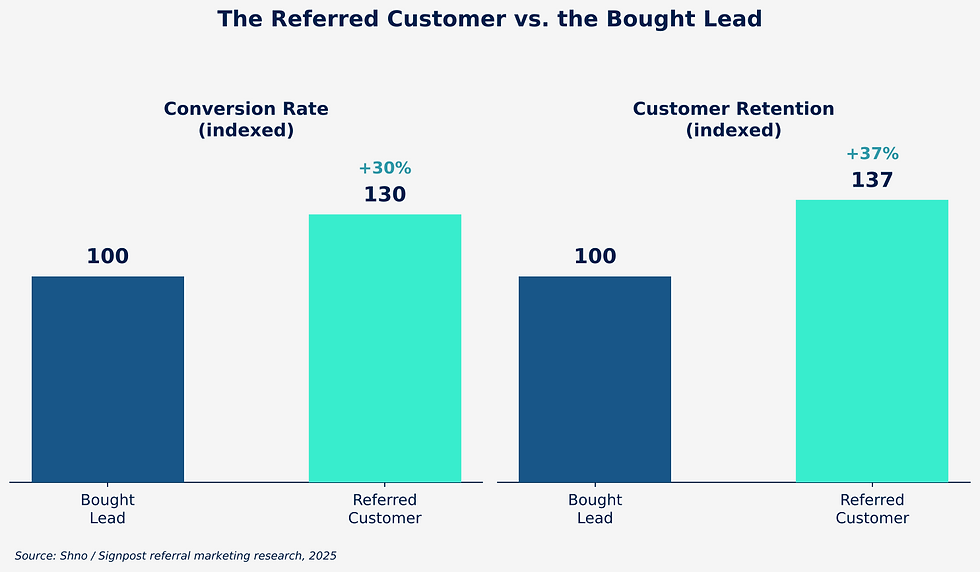
The ad channel is also getting more expensive every year, which makes the referral math better every year too, not worse. Cost per lead on Google ran close to seventy dollars in 2025, up from the year before, and cost per click rose almost thirteen percent in a single year. Running the paid channel blind, without knowing what a lead actually costs, means paying a rising price for a result you cannot even measure. A referral partner costs a conversation and splits nothing with an ad platform.

How to Get Referral Partners for a Small Business: Three Moves
1. Name the business one step ahead of you or one step behind
Write down the exact sequence your customer moves through before and after they find you. If you are a home remodeler, who sold them the house. If you are a caterer, who booked the venue. If you are a commercial cleaner, who finished the buildout before you walked in. There is almost always one obvious answer, and most owners have simply never written it down.
2. Make one call this month, not five
Pick the single best partner from that list and call them. Do not try to build a network of twenty referral partners in your first month. One real relationship, with one clear agreement about who sends what and how fast, beats a stack of business cards from a networking breakfast. Set up the trade in a ten-minute conversation: I will send you my customers who need what you do, you send me yours who need what I do, and we both track it so we know it is working.
3. Make it easy to send you business
A partner will send you customers once if you ask nicely. They will send you customers every month if the handoff is effortless on their end. Give them a simple way to pass a name and a phone number, whether that is a text, a shared form, or just your cell number and a standing promise to call that customer back the same day. The partnership dies the moment it becomes work for the other owner.
The Real Test
You will know it is working when a new customer tells you, unprompted, that so-and-so sent them. That is the signal that costs you nothing to track: ask every new customer how they found you, and count how many name your partner by name. When that number is growing every month without a matching rise in ad spend, the handoff is doing its job. The goal is not a bigger marketing budget. It is a channel that does not need one.
Bought leads will keep getting more expensive every year that climate holds. The business standing next to you, serving the same customer a week before or a week after you do, will not send you an invoice. Call them this month.
CTA: Find your weakest of five growth drivers with the free Profit Drivers Scorecard: https://www.profit-sensei.com/scorecard


Comments