
Small Business Strategy: Stop Copying the Fortune 500 Playbook


Sarah ran a 14-person marketing agency doing about $1.8 million a year. Before that she'd spent six years inside a Fortune 500 marketing department, watching quarterly OKRs turn a company's whole year into one spreadsheet everyone could see. When her agency's growth flattened, she reached for the same tool. She blocked three weeks, pulled her whole team into a planning offsite, and built a forty-slide strategy deck with cascading objectives down to the account coordinator level.
Three weeks later the deck was done. Nobody could recall what was in it by the second client fire that Friday. The agency burned roughly $40,000 in billable time it never got back, and the plan that was supposed to fix a flat quarter never made it past slide six in any real meeting after the offsite.
The framework wasn't wrong. Fortune 500 companies run on OKRs because they have ten thousand people who need to move in the same direction without talking to each other. Sarah has fourteen people who see each other every day. She didn't need a smaller version of the framework. She needed a different tool.
The Pattern
This is the wrong-sized advice trap. It catches owners who've spent time around big companies, in a past job, a client relationship, a conference stage, and picked up the language of enterprise strategy along the way. OKRs. Change management. Org design. Stakeholder alignment. The words sound serious, so installing them feels like progress. But a framework built to coordinate ten thousand people across four time zones is solving a problem you don't have at twenty employees.
That's typical, and it's not really about the framework. A confident owner hits a flat quarter, remembers a system from their old job or a business book, and installs the whole thing at full weight. Not because it's sized right. Because it's the one they already know.

Most owners at this size aren't short on confidence. A 2026 survey of 1,092 micro-business owners found 73% feel more confident running their business than they did in year one. But 57% report revenue flat or down over that same stretch. Confidence and growth split apart. Effort goes into planning documents, dashboards, and org charts sized for a company ten times bigger, and none of it moves the number that actually matters.
Why Small Business Strategy Breaks When It's Borrowed
Enterprise frameworks exist to solve a coordination problem. When a company has five hundred people spread across four departments, nobody can walk down the hall and ask what's happening. You need a written plan, a cascade of objectives, and a review cadence, because without one the company pulls in six directions at once. The framework's weight is the point. It's what holds a company together when the owner can't personally see everything.
A fourteen-person shop doesn't have that problem yet. Everyone already knows roughly what everyone else is doing, because they're in the same building or the same group chat. The coordination cost that justifies a heavy framework doesn't exist at this size. Install one anyway and you're not adding structure. You're adding a layer of translation between you and the people you could just walk over and talk to.
The framework isn't the failure. Importing it at full enterprise weight is. A one-page plan does the same job as a forty-slide deck when the distance between the owner and the work is three feet, not three levels of management. Most small business strategy advice fails owners for this exact reason: it was written by someone solving a coordination problem this size of business doesn't have yet.
There's a second cost nobody names. Every hour your team spends filling out a framework built for a bigger company is an hour they're not serving a customer. At Sarah's agency, three account managers spent parts of three weeks writing objectives and key results for departments that were, in practice, one person each. Writing a KR for a department of one isn't planning. It's paperwork wearing a planning costume. The bigger the borrowed framework, the more of your week it eats before it produces a single decision you can act on.
Your Small Business Strategy Filter
1. Name the one problem the framework claims to solve
Before you install anything, write one sentence: what breaks without this. OKRs solve "nobody knows what anyone else is working on this quarter." If your team already knows, without a spreadsheet, you don't have that problem, and the framework is solving something that isn't broken.
2. Cut it down to one page
Whatever the enterprise version looks like, your version fits on one page. One page you and your team can actually reread on a Monday morning, not a deck that lives in a shared drive nobody opens twice. If you can't fit the plan on one page, you haven't finished thinking it through, you've just added more slides.
3. Test it on one team before you roll it out everywhere
Run the trimmed-down version with one team or one project for thirty days before you hand it to the whole shop. If it doesn't save time inside thirty days, it's not the right tool at your size, no matter how well it worked somewhere else. A framework that needs a consultant to explain it every quarter isn't free just because the book was.
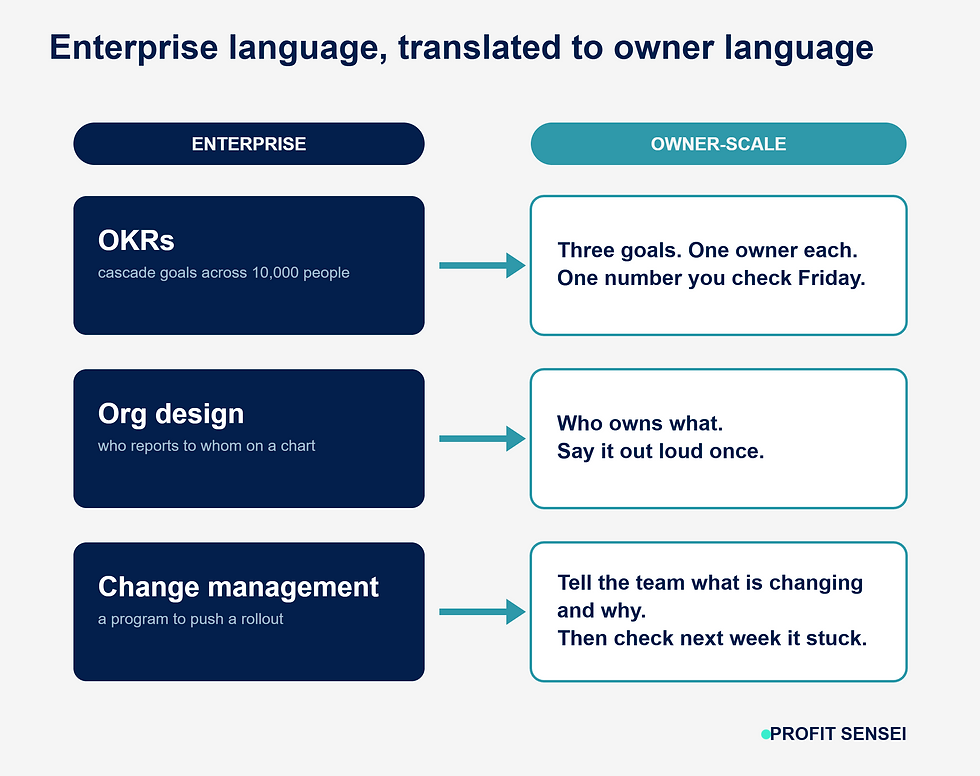
This is the whole engine behind Profit Sensei: enterprise instincts without enterprise weight. Be nimble, shorten the feedback loop, focus on the outcome instead of the process. That mindset works at any size. The paperwork built to enforce it at ten thousand people is the part you leave at the door.
The Real Test
You'll know the filter worked when the plan fits on one page, your team can repeat it back to you without opening a document, and it took you a day to build instead of three weeks. If you're still explaining what the plan means a month later, the framework won and you lost. Go back and cut it in half.
Sarah eventually did this. She threw out the forty-slide deck, sat with her three team leads for one afternoon, and wrote a single page: three goals, one owner each, one number that would tell her by Friday if it was working. Revenue moved before the quarter was out, not because the new plan was smarter than the old one, but because everyone could actually hold it in their head instead of opening a shared drive to remember it.
None of this means enterprise experience is wasted on a small business. It's the opposite. The instinct that made the framework work at a big company, get everyone pointed at the same target, is exactly what a fourteen-person shop needs too. What doesn't survive the trip is the paperwork built to enforce that instinct across ten thousand people who will never meet each other. Keep the instinct. Leave the deck behind.
Run the Profit Drivers Scorecard to find out which of the five growth drivers is actually costing you the most right now: https://www.profit-sensei.com/scorecard


Comments